राज्य
Sikkim Proposes Steep Electricity Tariff Hikes for 2026–27 Amid Mounting Financial Pressures
Bishnu Neopaney
२०८३ श्रावण २४, शनिबार
१०:१५ बजे | अद्यावधिक: १०:४५
266 पटक हेरिएको
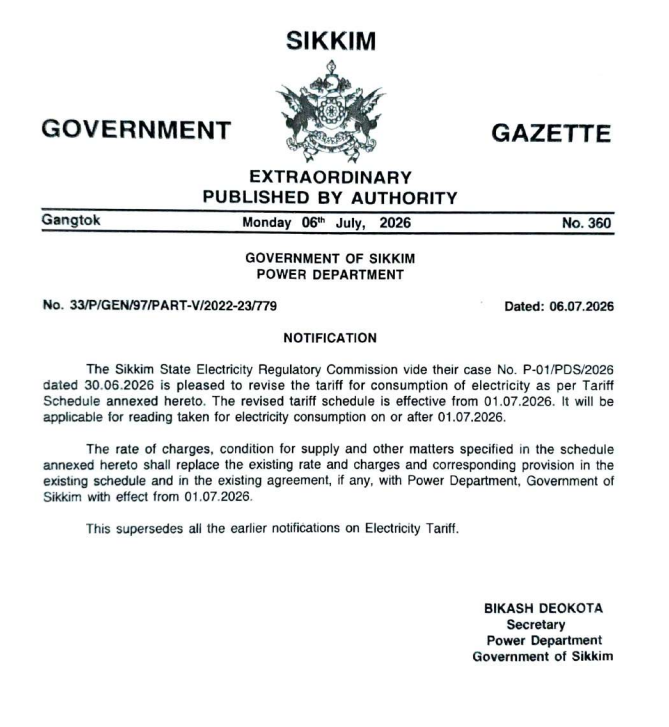
GANGTOK, 15 SEPT — Electricity consumers in Sikkim are facing a higher tariff burden following the implementation of revised power rates from July 1, earlier this year, with the Power Department now seeking further tariff hikes across domestic, commercial and industrial categories for 2026–27 through a revised proposal submitted to the Sikkim State Electricity Regulatory Commission (SERC).
The proposed revisions are a response to a projected revenue gap of ₹162.06 crore. According to the department, this deficit is primarily driven by escalating power procurement expenses, fuel-related charges, and Ash Handling Charges levied by PTC India Ltd. The net Aggregate Revenue Requirement (ARR) for the upcoming fiscal year is estimated at ₹741.94 crore, while projected revenues under existing tariffs and outside-state power sales stand at ₹579.88 crore.
To bridge the financial shortfall without shifting the entire burden onto consumers—which the department warns could trigger adverse socio-economic consequences—the proposed model combines targeted tariff hikes with supplementary State Government budgetary support.
Impact on Domestic and Commercial Consumers
Under the newly filed tariff structure, domestic energy charges would increase by ₹1 per unit across all major consumption slabs. Households consuming up to 50 units would see rates rise from ₹1.60 to ₹2.60 per kilowatt-hour (kWh), while consumption exceeding 400 units would climb from ₹4.60 to ₹5.60 per kWh. The proposal also introduces monthly minimum charges of ₹100 for single-phase connections and ₹200 for three-phase domestic connections.
Commercial entities face even sharper increases, with proposed rates climbing by ₹1.15 to ₹1.25 per unit. For businesses such as hotels, restaurants, and retail shops using up to 50 units, rates would jump from ₹4.10 to ₹5.25 per unit, and usage above 400 units would cost ₹8.55 per unit, up from ₹7.40. For Sikkim's tourism-reliant economy, these adjustments threaten to significantly inflate operational overheads.
Additionally, the proposal outlines structured changes for industrial and bulk-supply consumers, including demand-based charges for larger loads and Time-of-Day tariffs for high-tension consumers to incentivize off-peak energy usage.
Regulatory Scrutiny and Balancing Act
The financial strain highlighted in the proposal stems heavily from Sikkim's reliance on external power purchases. The state projects long-term procurements of 778.28 million units (MUs), short-term purchases of 209.72 MUs, and 233.81 MUs of free power. Even with the proposed tariff revisions and estimated revenues from surplus power sales outside the state, a residual deficit of approximately ₹86.13 crore is expected to remain, requiring intervention from state funds.
Before any changes are finalized, the SERC is tasked with reviewing minor discrepancies noted within the revised petition regarding energy sales, power-purchase figures, and industrial-consumption projections. The commission must carefully weigh these adjustments against consumer affordability and the long-term financial viability of the state’s power infrastructure.
Mid-Term Relief: 5% Energy Rebate Reinstated
In a related regulatory development addressing current billing cycles, the SERC issued a mid-term modification to its annual framework, reinstating a 5% energy charge rebate for all domestic and commercial consumers for the entirety of the 2026–27 fiscal year.
The order followed a legal application by the State Power Department concerning operational delays in deploying smart prepaid metering infrastructure. While the commission noted that the request did not meet the strict procedural thresholds of a formal judicial review, it exercised its dynamic oversight powers to convert the matter into a Miscellaneous Application.
Effective August 1, 2026, the 5% rebate has been fully reinstated, while a separate 1% rebate previously allotted specifically for smart-metered consumers has been withdrawn to prevent overlapping financial incentives. The Power Department has been directed to reflect the adjustment in upcoming billing cycles, with the exact financial variance to be formally evaluated during the statutory Annual True-Up exercise.
As the SERC evaluates the comprehensive tariff proposals for the upcoming fiscal year, the commission continues to balance the operational realities of the state's utility providers with essential consumer interest safeguards.
अनलाइन् खबर पत्रिका तथ्य जाँच र आचारसंहिता प्रतिवेदन:
यो सामग्री हाम्रा सम्पादक टोलीद्वारा तथ्य प्रमाणीकरण र प्रेस काउन्सिल अफ इन्डिया आचारसंहिता बमोजिम प्रकाशित गरिएको हो।