राष्ट्रिय
Trump’s Shadow Hangs Over BRICS as Modi Hosts Putin and Xi in Delhi
Special Correspondent
२०८३ श्रावण २४, शनिबार
१०:१५ बजे | अद्यावधिक: १०:४५
48 पटक हेरिएको
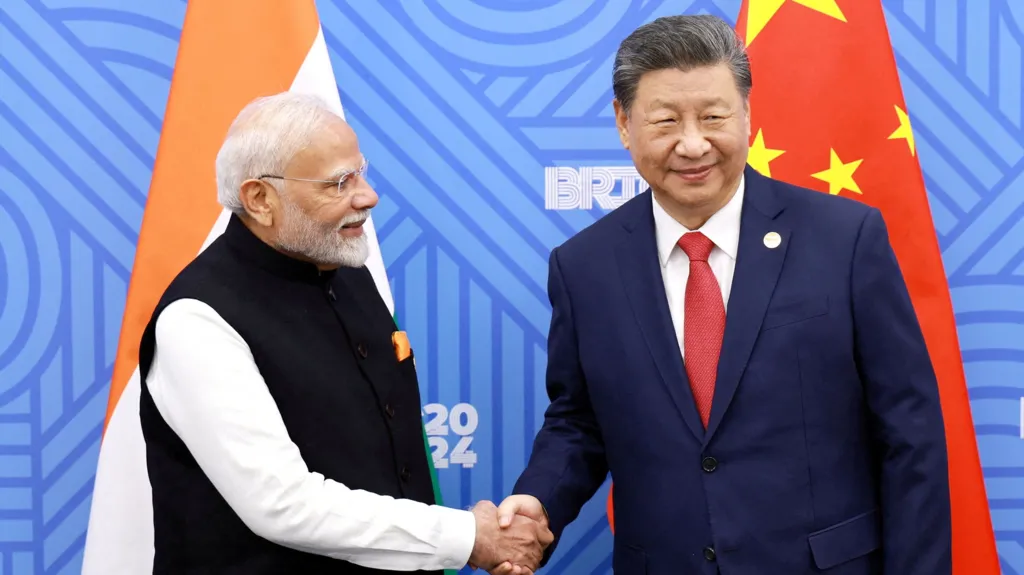
NEW DELHI, 11 SEPT: The United States is not a member of BRICS, but President Donald Trump is expected to loom large over the group’s summit in New Delhi this weekend.
Leaders from 11 BRICS nations — including India, China, Russia, Brazil, South Africa, the UAE and Iran — are gathering for talks on global trade, finance, security and geopolitics. Saudi Arabia is also attending as an invited member.
Yet few issues are likely to be more consequential than the impact of Trump’s policies on the global economy and international order.
The conflict involving Iran, along with the continuing threat of US tariffs against both rivals and allies, has disrupted energy markets and increased uncertainty over the direction of global trade.
Against this backdrop, BRICS leaders are unlikely to agree on a strongly worded statement directly confronting Washington. The group remains deeply divided over how aggressively it should challenge US influence.
“India cannot afford to have a joint statement that rails against Washington,” said Michael Kugelman, a senior fellow at the Atlantic Council. He expects any criticism of US policies to be “vague and indirect”, reflecting the sharply different interests of BRICS members.
Russia and Iran may favour a stronger anti-US position, but India has its own reasons for avoiding confrontation. New Delhi is reportedly nearing a trade agreement with Washington and will be reluctant to endorse language that could provoke the White House.
China, meanwhile, is also likely to be cautious about allowing BRICS to become an overt platform for challenging the United States.
The UAE presents another complication. The Gulf state has faced Iranian attacks during Tehran’s retaliation against US and Israeli strikes and hosts US military forces. Abu Dhabi is therefore unlikely to support a statement that could be seen as advancing Iran’s position.
The expansion of BRICS has increased its economic and geopolitical weight, but it has also made agreement more difficult.
“You've added a number of members that don't get along,” Kugelman said, pointing to the challenge of bringing together countries with very different views of the global order.
Trump’s Challenge to BRICS
Trump has repeatedly criticised BRICS, particularly its efforts to reduce dependence on the US dollar — a process commonly described as de-dollarisation.
He has warned BRICS countries against creating an alternative currency or taking steps that could weaken the dollar’s dominant position in international trade.
In November 2024, Trump threatened BRICS members with 100% tariffs if they supported replacing the US dollar with another currency.
That threat is likely to remain in the background as leaders discuss ways to strengthen financial cooperation and expand the use of local currencies in cross-border trade.
Such measures are particularly important for Russia and Iran, both of which face extensive US sanctions.
A Growing Global Bloc
Despite its internal divisions, BRICS has grown significantly over the past decade.
The expanded grouping now represents about 49% of the world’s population, 40% of global GDP and 26% of international trade, according to BBC Monitoring analysis.
Its most significant institutional achievement is the New Development Bank, which has financed billions of dollars in infrastructure and development projects, particularly across the Global South.
BRICS has also established a $100bn contingency reserve arrangement designed to provide financial support to members facing economic crises, although the mechanism has yet to be tested in a major crisis.
At the Delhi summit, leaders are expected to explore further financial cooperation and discuss ways to make payments between member countries easier without relying heavily on the dollar.
BRICS is also likely to renew calls for reforms to institutions such as the United Nations, International Monetary Fund and World Bank. Many developing countries argue that these institutions no longer adequately reflect the distribution of global economic and political power.
A Test for Modi’s Global Ambitions
For India, the summit is about more than BRICS.
Prime Minister Narendra Modi has sought to position India as a leading voice of the Global South and an advocate for a more multipolar international system.
Many of New Delhi’s priorities — including stronger representation for developing countries, multilateralism and freer global trade — overlap with the broader BRICS agenda.
But India faces a major challenge in balancing its ambitions with China’s growing influence across the grouping and throughout the developing world.
Kugelman said India’s efforts to establish itself as a leader of the Global South have achieved only limited success in parts of Africa and Latin America, where China has built deeper economic and diplomatic relationships.
The BRICS expansion nevertheless gives New Delhi an opportunity to strengthen ties with countries such as Ethiopia, Brazil and Indonesia and increase its influence across emerging markets.
Can India Deliver a Consensus?
For India, one of the biggest tests will be whether it can secure a joint BRICS declaration.
A consensus statement is often regarded as an important measure of a host country’s diplomatic success. But sharp differences over the Iran conflict, relations with Washington and the future of global trade could make agreement difficult.
The problem was already visible in May, when BRICS foreign ministers failed to reach agreement on a joint statement because of disagreements over the Iran war. India was forced to issue a chair’s summary instead.
New Delhi will draw some confidence from its experience hosting the G20 in 2023, when it successfully negotiated a joint declaration despite deep divisions over Russia’s invasion of Ukraine.
This time, however, India will want more than a diplomatic compromise. It will seek concrete announcements that demonstrate BRICS can deliver results rather than becoming merely a forum for discussion.
Financial cooperation is expected to be one area where members can make progress. Leaders are also likely to address major geopolitical developments, although any references to the United States will probably be carefully worded to avoid direct confrontation.
Washington, meanwhile, will be watching closely.
Modi’s High-Stakes Meetings
The summit will also provide an important opportunity for bilateral diplomacy.
Modi’s meeting with Chinese President Xi Jinping on Saturday will attract particular attention as India and China continue their cautious efforts to rebuild relations.
The two countries have made some progress in recent years, but their relationship remains marked by strategic competition and unresolved differences.
Modi is also expected to meet Russian President Vladimir Putin, with the war in Ukraine likely to feature prominently.
When Modi met Putin last month on the sidelines of the Shanghai Cooperation Organisation summit in Bishkek, he made a public appeal for peace. Although some interpreted the comments as criticism of Moscow, Russia publicly welcomed Modi’s efforts.
Economic issues are also likely to feature in India’s bilateral discussions with both Russia and China, particularly as New Delhi’s trade deficit with the two countries continues to grow.
More Than a BRICS Summit
Ultimately, the Delhi summit is an opportunity for BRICS to demonstrate that its growing economic weight can translate into greater global influence.
For India, however, the stakes are even higher.
New Delhi is seeking to strengthen its position as an independent global power capable of maintaining relationships with Washington, Moscow, Beijing and the wider developing world simultaneously.
The summit comes at a time when India’s diplomatic profile has faced competition from Pakistan, including Islamabad’s recent involvement in Middle East mediation efforts surrounding the Iran conflict.
“This is an important opportunity for India to reassert its global significance and its global leadership,” Kugelman said.
In that sense, the summit may be as important for India as host as it is for BRICS itself.
If Modi can bridge the group’s deep divisions, deliver a consensus statement and secure meaningful agreements on trade and finance, Delhi could emerge from the summit with its claim to global leadership significantly strengthened.
अनलाइन् खबर पत्रिका तथ्य जाँच र आचारसंहिता प्रतिवेदन:
यो सामग्री हाम्रा सम्पादक टोलीद्वारा तथ्य प्रमाणीकरण र प्रेस काउन्सिल अफ इन्डिया आचारसंहिता बमोजिम प्रकाशित गरिएको हो।